
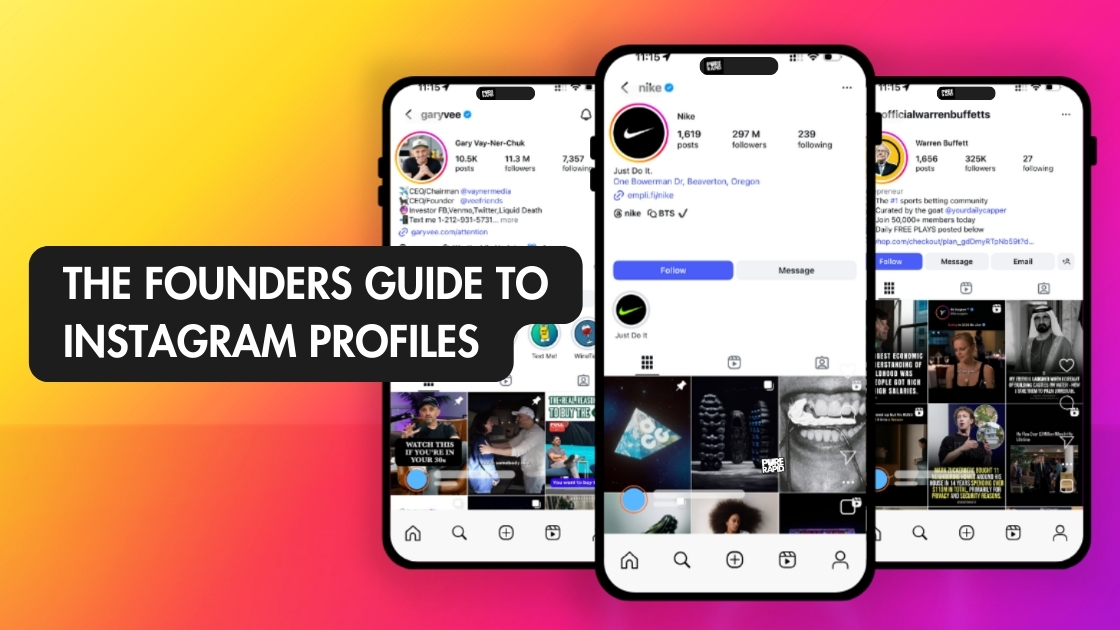
The Founder’s Guide to Instagram Profiles
How entrepreneurs should actually set up their Instagram profile, without looking lazy, try-hard, or wasting time.
Most Instagram advice is written for influencers.
Founders are not influencers.
They run companies. They manage staff, customers, suppliers, growth, margins and actual commercial decisions. They are not sitting around wondering what Reel to post next.
So when someone says, “you need to build a personal brand on Instagram”, the reaction most founders quietly have is one of three things.
Scepticism. Confusion. Or resistance.
Because the real question is not how to grow on Instagram.
The real question is much simpler.
Do I even need Instagram at all?
And if I do, what should it actually look like?
Because nobody wants to look lazy. But nobody wants to look like they are trying too hard either.
This guide answers that properly.
Not with generic social media advice. Not with influencer logic.
With a clear roadmap for founders, operators and entrepreneurs who want to make the right decision once, then move on.
If you want the short answer before the deep dive, here it is.
- Private founder who values privacy and already has a strong network: use a minimal profile.
- Founder building personal credibility in an industry: use a Creator account.
- Company or brand page: use a Business account.
- Founder building an audience and public authority: use a Creator account with clear content pillars.
- Running ads: handle this through Meta Business Manager, not by trying to turn your founder profile into a company account.
- Posting content: optional. Only do it if it supports the business and suits how you operate.
The rest of this guide shows why.
Choose your founder path
Different founders use Instagram for different reasons. That is where most confusion starts. People assume there is one correct approach, when in reality there are several valid paths.
Choose the one that feels closest to how you actually operate.
Quiet operator
You prefer privacy. You already have a strong network. You do not want pressure to post.
Digital business card
You want people to find you, verify you, and understand you quickly, without becoming a content creator.
Reputation builder
You want your profile to quietly support authority in your industry.
Founder marketer
You want your profile to support the business through insight, perspective and occasional visibility.
Brand-first founder
You want the company to be the focus, not you.
Why Instagram matters for founders
For most founders, Instagram is not mainly a discovery platform.
It is a credibility checkpoint.
People look at your profile when they:
- search your name
- research your business
- meet you at an event
- consider working with you
- hear your name through a referral
They are trying to answer basic questions.
- Is this person real?
- What do they do?
- What kind of business are they building?
- Do they feel credible?
That is why Instagram matters even for founders who barely use it. The platform is often part of the due diligence process, whether people admit it or not.
Instagram is not mainly about growth hacks. For founders, it is often about identity, trust and first impressions.
The five founder archetypes
Most founders fall into one of five patterns. Once you know which one you are, the settings become much easier to choose.
1. The private operator
You already have traction, relationships or referrals. You do not want visibility for the sake of it. You want the business to do the talking.
Best fit: minimal profile or digital business card profile.
2. The reputation builder
You want people to understand your thinking, standards and experience, but you are not trying to become an influencer.
Best fit: Creator account, low-pressure content, category optional, clear positioning.
3. The founder marketer
You want your founder presence to support commercial growth. You are comfortable sharing perspective, lessons and selected behind-the-scenes insights.
Best fit: Creator account with a proper content strategy.
4. The brand operator
You want the company page to carry the weight. The founder account exists, but the business brand leads.
Best fit: Business account for the company, minimal or light-touch founder presence.
5. The audience builder
You want reach. You want authority at scale. You want a stronger public identity.
Best fit: Creator account with a defined content niche and consistent output.
The Founder Instagram Alignment Framework
The biggest mistake founders make is trying to solve Instagram at the settings level. That is too low-level.
The strategic way to think about it is this:
Identity. Intent. Interaction.
Identity
Who does the profile represent?
- you as a founder
- your company
- your expertise
- your audience-facing public identity
Intent
Why does the profile exist?
- credibility
- visibility
- audience building
- customer acquisition support
- minimal online presence
Interaction
How active will the account be?
- minimal interaction
- occasional interaction
- active publishing and engagement
When identity, intent and interaction match, the profile feels coherent. When they do not, it feels confused.
That is why some founder profiles feel sharp in seconds and others feel vague even when they have more content.
The Founder Visibility Spectrum
Founders often think visibility is binary. It is not. There is a spectrum.
Invisible
No public presence. This can work, but it removes an easy trust checkpoint when people search your name.
Minimal presence
A basic account exists to confirm identity. Little or no content. Clear, simple, low maintenance.
Credibility builder
Selected posts, measured insight, clear positioning. Enough to show you think well and operate seriously.
Authority builder
More consistent educational and perspective-led content. The founder becomes known beyond their immediate circle.
Audience builder
A deliberate public strategy. Content output, consistency, audience growth and visibility all matter.
The right question is not, “How visible should I be?”
It is, “Where on this spectrum actually supports the business I am building?”
Personal vs Creator vs Business
Instagram gives you three core account structures. They exist for different reasons.
| Account type | Best for | Main pros | Main cons |
|---|---|---|---|
| Personal | Purely social use, private individuals, low interest in visibility or analytics | Simple, private-feeling, low pressure | No professional insights, fewer business-facing tools |
| Creator | Founders, experts, public-facing individuals, authority builders | Professional dashboard, insights, message controls, creator features | Less suited to pure ecommerce or shop-led setup |
| Business | Brand pages, product businesses, company-first accounts | Business tools, promotions, clearer company structure | Feels more corporate on a personal founder profile |
When Personal makes sense
If you use Instagram socially and do not care about visibility, authority, analytics, or platform tools, a Personal account is fine.
When Creator makes sense
This is usually the best default for founders because it is designed for a person, not a company. It gives you flexibility without making your account feel like a corporate brand page.
When Business makes sense
Use this when the account is representing the company itself. Brand pages, product businesses, retail, hospitality and similar accounts often belong here.
The simple rule: if the profile represents a person, Creator is usually the best fit. If the profile represents the company, Business is usually the better fit.
Category labels explained
Instagram lets professional accounts choose a category label such as Entrepreneur, Founder, Coach, Digital Creator or similar. It also lets you choose whether that category is displayed on the profile.
This matters for perception, not magic. It is a clarity tool.
Showing the category label
- gives immediate context
- helps strangers understand what the account represents
- can strengthen positioning for founders in business-facing industries
Downside: it can feel a little corporate or slightly too polished on a personal profile.
Hiding the category label
- creates a cleaner profile
- feels more natural and less performative
- still allows the account to stay within the professional structure
Downside: visitors need to read the bio or click further to understand what you do.
The strongest middle ground for many founders
Select a relevant category, then hide it.
This gives you the underlying professional structure while keeping the front-end profile cleaner.
The digital business card profile
This is one of the most under-discussed founder profile strategies online, and one of the most useful.
Instead of using Instagram as a content channel, you use it as a verification checkpoint.
What it looks like
- real photo
- name clearly visible
- category selected, often hidden
- little or no bio
- one link to a proper founder page, operator profile or company site
Why it works
Instagram bios are tiny. Serious operators often have much more to say than a two-line bio can hold.
A proper founder page on your own site can explain:
- your background
- your journey
- what you build
- who you are for
- who you are not for
- what you value
- the kind of businesses you want to build
In that setup, Instagram is not the place where the full story lives. It is the doorway.
Who this is ideal for
- founders with strong networks
- operators who value privacy
- people who dislike social media performance
- business owners who want a clean, credible online footprint without constant posting
The quiet operator and minimal presence strategy
There is a founder type most social media marketers ignore.
The successful one who simply does not want to perform online.
That founder is not wrong. They are not behind. They are not missing something automatically.
They may already have:
- a good network
- steady referrals
- a business that is already where they want it to be
- no interest in public commentary
For that person, pressure to post is noise, not strategy.
What the minimal presence profile should include
- a real profile photo
- their real name
- optional short descriptor
- a link to the company or founder page
What it does not need
- daily posting
- opinion threads
- forced personal brand content
- performative lifestyle updates
There is no rule that says a successful founder has to become a content creator.
Content strategy for founders who do want to post
If you decide that Instagram should support your business publicly, the answer is not to post randomly.
It is to define a content role.
What founder content should do
- build trust
- show standards
- demonstrate perspective
- create relevance with the right people
Strong founder content pillars
- Industry insight: what you are seeing, learning, noticing
- Behind the scenes: selected operational reality, not vanity
- Lessons learned: what experience has taught you
- Education: clear, useful guidance for your audience
- Selected lifestyle: only where it adds context, trust or relatability
What not to do
- copy influencer formats that do not suit your business
- post because you feel guilty
- share content with no commercial or reputational role
- force volume when quality and consistency would be better
Ads, collabs and partnerships
This is where a lot of founders get tangled up.
Running ads
Your founder profile is not your ad account. Ads are managed through Meta’s ad infrastructure, usually via Meta Business Manager and Ads Manager. Professional accounts can also access promotion and ad tools.
So the correct thinking is:
- the Instagram profile affects perception
- the ad account structure affects advertising operations
Do not turn your founder profile into something awkward just because you plan to run paid media.
Collabs and partnership activity
If partnerships matter, Creator and professional account structures make more sense because Instagram and Meta provide collab and partnership-ad functionality within the professional ecosystem.
What this means in practice
- If your founder profile is personal-facing but commercially useful, Creator is often the cleanest setup.
- If your company itself is the promotional vehicle, the company account should usually be Business.
- If an agency or internal team runs ad spend, handle permissions and assets properly in Business Manager rather than muddling profile identity.
Know your audience properly
One of the biggest misses in founder Instagram strategy is failing to think like a marketer for a second.
Not in a gimmicky way. In a real way.
You need KYC. Know your customer.
Ask these questions
- Who is likely to follow or check this profile?
- What do they want from me?
- Why would they care?
- What would make them trust me faster?
- What would make them lose interest?
For founders, the audience is often not just customers. It can include:
- prospective clients
- referral partners
- suppliers
- future hires
- industry peers
- potential acquirers or investors
That is why founder profiles are often more strategic than they first appear.
The 10 founder mistakes that quietly damage credibility
1. Copying influencers
Influencers make money from attention. Founders make money from businesses. Different game.
2. Confusing the founder profile with the company account
These can support each other, but they should not feel like clones.
3. Having no clear profile role
If you do not know why the profile exists, the audience will not know what to do with it either.
4. Looking abandoned
A dead profile with weak signals can create doubt. Better a minimal intentional profile than a neglected one.
5. Looking too polished
Founders who over-brand everything often lose the human edge.
6. Over-explaining in the bio
If you need depth, use your own website. Instagram is not the best place to tell your full life story.
7. Posting without content pillars
Random content erodes identity.
8. Performing expertise instead of showing it
People can feel the difference.
9. Using a logo on a founder profile
People trust people more than symbols when the profile is about a person.
10. Feeling forced to post
Pressure produces poor content. Intent produces better choices.
The 60-second founder Instagram decision test
Answer these honestly.
- Do you want Instagram to bring visibility or customers to the business?
If yes, a Creator strategy may make sense. If no, minimal presence may be enough. - Do you want the company to be the focus, not you?
If yes, build around a Business account for the company. - Are you comfortable sharing ideas and perspective publicly?
If yes, founder-led content can work. If no, stay light-touch. - Is your business already growing through referrals and network strength?
If yes, you may only need credibility signals rather than active content. - Do you want to sell directly through Instagram shopping-style features?
If yes, a Business account is usually more relevant for the company page.
If you answered mostly no to public visibility questions, stop trying to force a creator identity on yourself.
If you answered mostly yes, build properly rather than half-doing it.
The founder decision tree
Start here
Do you want to post content regularly?
If no, choose a minimal profile or digital business card profile.
If yes, move to the next question.
Do you want the company or you to be the focus?
If the company should be the focus, build the company account as a Business account.
If you should be the focus, use a Creator account.
Do you want direct product-selling features on the company side?
If yes, strengthen the company Business account.
If no, your founder account can stay Creator-led and support visibility, trust and commercial relevance without trying to become a storefront.
The Founder Profiles Wall
Most founders do better when they can see patterns, not just theory.
The quiet operator
Looks like: real photo, minimal profile, maybe no posts, link to website.
Why it works: the profile confirms identity and nothing more is required.
The digital business card
Looks like: founder photo, clean name, optional hidden category, single strong link.
Why it works: Instagram points people to the real story elsewhere.
The credibility builder
Looks like: Creator account, clear bio, occasional insight posts.
Why it works: enough activity to demonstrate thinking without becoming a content machine.
The authority builder
Looks like: regular content, sharp positioning, clear voice, selected personal context.
Why it works: thought leadership compounds over time when it is real and useful.
The founder marketer
Looks like: content designed to support trust, commercial positioning and audience fit.
Why it works: the founder becomes part of the business growth engine.
The brand operator
Looks like: strong company page, light founder presence.
Why it works: the brand carries attention and the founder stays in the background.
Three founder scenarios that make this easier
Scenario 1: the established quiet operator
This founder runs a serious business, already has a network, and does not want to perform online. Their best move is a real photo, clean account, and one useful link. They do not need to start posting motivational captions to justify themselves.
Scenario 2: the credibility-focused specialist
This founder works in a specialist field where trust matters. They do not need to become famous. They just need people to see they are sharp, thoughtful and real. Creator account. Clear bio. Occasional insight. Done.
Scenario 3: the growth-focused founder
This founder wants more market visibility, stronger top-of-funnel trust and better personal positioning. They should stop posting at random and instead build real content pillars with a Creator account and a clear reason for every post.
The founder Instagram profile audit tool
Use this to assess whether your current profile is helping or hurting you.
Identity
Can someone understand who this profile represents in under five seconds?
Intent
Is it obvious why this profile exists? Credibility, visibility, audience building, or simple online presence?
Clarity
Does the profile photo, name, bio and link work together?
Consistency
Does the account behaviour match the strategy? A quiet founder profile should feel intentionally minimal, not neglected. A visible founder profile should feel coherent, not random.
Alignment
Does the profile feel natural to you? Or does it look like you are copying a strategy that belongs to someone else?
A strategic perspective on founder visibility
For founders, visibility is not really a social media question.
It is a strategy question.
Some founders benefit from visibility because trust, reach or market education support growth. Others gain almost nothing from public posting because their business is relationship-led, referral-led or deliberately private.
Neither approach is inherently better.
What matters is alignment between visibility and the business being built.
The strongest founders do not adopt platforms emotionally or because somebody on the internet told them they “need a personal brand”.
They ask better questions.
- Does this increase trust?
- Does this create opportunity?
- Does this support the direction of the business?
- Does this suit how I actually operate?
If the platform supports the mission, use it. If it becomes noise, ignore it.
People Also Ask
These are the questions founders and business owners most often have when trying to make the right Instagram decision.
Should entrepreneurs use a Personal or Creator Instagram account?
If the account represents the founder and not just social life, Creator is usually the better choice. It gives you more flexibility, better professional tools and cleaner positioning for a founder profile. Personal is fine if you genuinely only use Instagram socially.
Should founders use a Business account on Instagram?
Use a Business account when the account represents the company or brand. For founder profiles, Creator is usually a better fit because it keeps the account person-led rather than corporate.
Does a Creator account get more reach than a Personal account?
The better way to think about this is not “which account type gets more reach?” but “which setup best supports how I want to use the platform?” Instagram positions professional accounts around tools, insights and controls, not magic reach advantages.
Can you run ads from a Creator account?
Yes. Paid media is handled through ad tools and Meta’s ad infrastructure, not by turning your founder profile into a company page.
Do founders need to post content on Instagram?
No. Many strong founders use Instagram as a credibility checkpoint only. Posting becomes worthwhile when it supports visibility, trust, authority or audience growth in a way that matters commercially.
Should founders hide their category label?
Usually, yes if they want a cleaner founder profile. Showing the label can help with immediate clarity. Hiding it often feels more natural. The right choice depends on how formal or polished you want the profile to feel. Instagram allows professional accounts to show or hide category information.
What category should a founder choose on Instagram?
Choose the category that most accurately reflects how you want the profile understood. Entrepreneur, Founder and similar options often work because they create quick context. The point is clarity, not impressiveness.
Should a founder use a real photo or a logo?
If the profile is about the founder, use a real photo. People trust people faster than logos when they are trying to understand who is behind a business.
What should a founder put in their Instagram bio?
Only what helps someone understand who you are, what you build, and where to go next. If your story is bigger than a short bio, use the link to send people to a stronger founder page on your own site.
How often should entrepreneurs post on Instagram?
As often as you can sustain without diluting quality or making the platform feel like a chore. Consistency matters more than trying to look busy.
Should founders separate their personal and company Instagram accounts?
Usually, yes. The founder account and company account can support each other, but they serve different roles. One represents a person. The other represents a business.
Is Instagram useful for B2B founders?
It can be, especially as a credibility layer. Not every B2B founder needs to build an audience there, but a coherent profile can still support trust when prospects, partners or hires look you up.
Do private or blank Instagram accounts hurt credibility?
They can if they look neglected or confusing. A deliberately minimal profile can work very well. The difference is whether it looks intentional.
Can a founder grow a business without using Instagram?
Absolutely. Plenty of founders grow through referrals, networks, direct outreach, reputation, paid media, partnerships and other channels. Instagram is a tool, not a requirement.
How do entrepreneurs use Instagram without posting?
By using it as a digital business card. Real photo, clean profile, strong link, and enough clarity that someone who checks the account can confirm who you are.
The final framework
If you want the clearest possible summary, here it is.
Private founder
Use a minimal profile or digital business card profile.
Founder building credibility
Use a Creator account with a clean profile and selected insight.
Company brand page
Use a Business account for the company itself.
Founder building authority
Use a Creator account with clear pillars and consistency.
Running ads
Manage this through Meta Business Manager and proper asset setup.
Posting frequency
Only post as much as supports the business and fits your natural operating style.
Final thought
Instagram is not mainly a social media choice for founders.
It is a positioning choice.
Some founders build audiences. Some founders build companies quietly. Both approaches can work.
The goal is not to copy the loudest people online. The goal is to choose a profile structure that supports the business you are actually building.
When that happens, the pressure disappears. The profile becomes clear. And so does the decision.